Disclaimer: This post contains affiliate links. As an Amazon Associate and member of other affiliate programs (including Temu), I earn from qualifying purchases. If you click a link and make a purchase, I may receive a small commission at no extra cost to you. I only recommend gear I genuinely trust.
If you’ve ever tried to fish a shallow weed bed on Chemong or Buckhorn Lake at 2:00 PM on a gorgeous July Saturday, you already know the frustration. Between the massive wake boats sending four-foot rollers over your bow and the jet skis buzzing thirty yards away, the shallow-water bass bite gets completely obliterated. The fish don’t leave the lake, but the sheer noise and intense sunlight force them to bury themselves so deep into the dark, tangled heart of the weeds that they become near-impossible to tempt.
But if you are willing to set an alarm before the sun breaks the horizon, or stay out on the water until the stars begin to pop out, you will experience the most explosive, heart-stopping bass fishing the Kawarthas have to offer.
When the pleasure boaters are still asleep or packing up for dinner, the lake goes glass-calm. That is when the heavy-class Largemouth and Smallmouth Bass slip out of their heavy cover and cruise the shallow flats like apex predators looking for an easy meal.
The Dawn Patrol: Frog Fishing the Slop
There is nothing quite like the silence of a Kawartha mist rising off a field of wild rice or lily pads at 5:30 AM, only to have that silence shattered by a five-pound largemouth completely turning the water inside out.
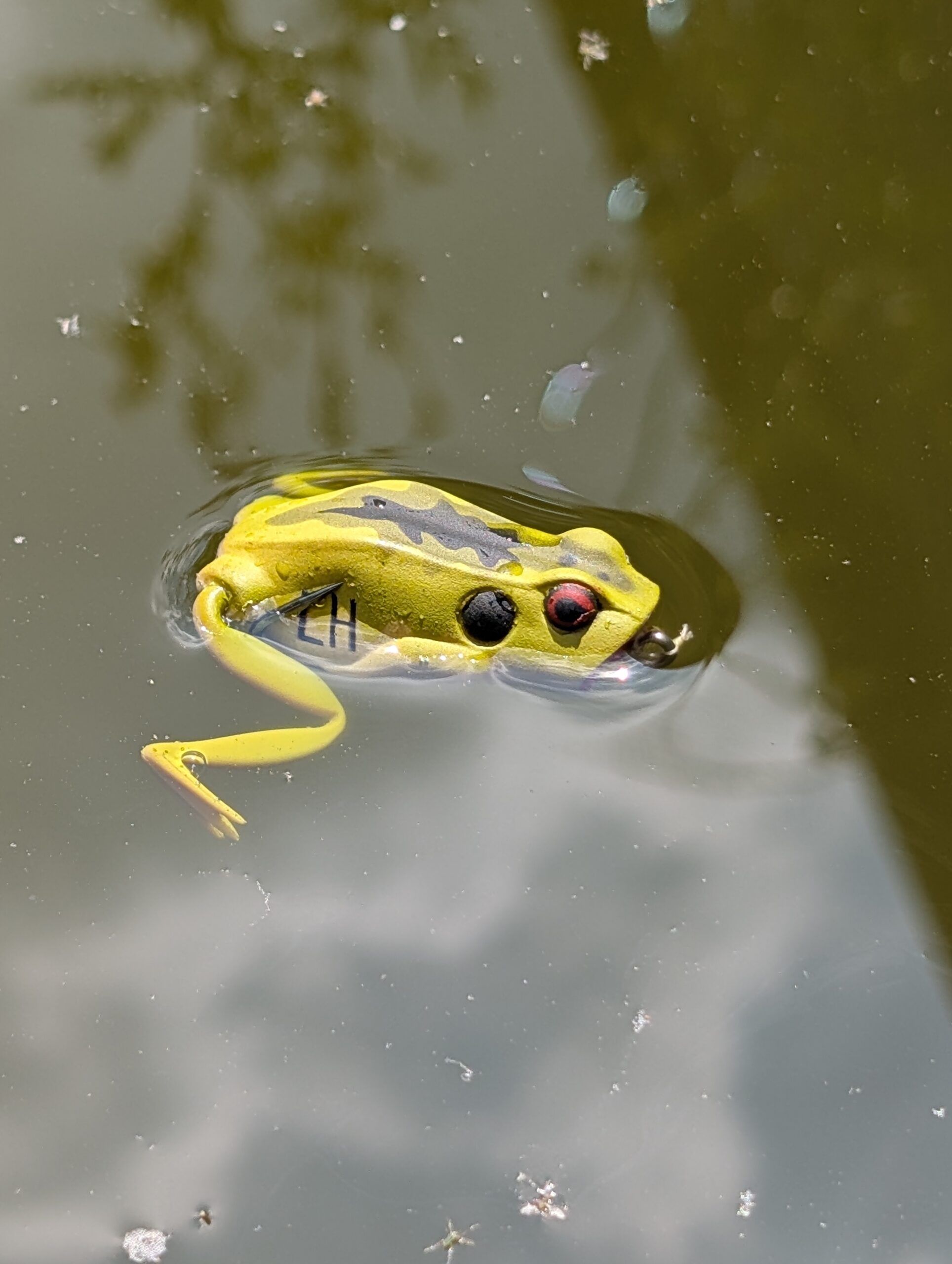
When the light is low, bass feel incredibly secure moving into water as shallow as 18 inches to hunt frogs, mice, and dragonflies. This is where a hollow-body weedless frog becomes your best friend.
- The Gear: Do not bring a light spinning rod to a frog fight. You need a 7’3″ to 7’6″ heavy-action baitcasting rod paired with a high-speed reel and spooled with nothing less than 50-lb or 65-lb braided line. Monofilament will stretch and snap, and fluorocarbon sinks, which pulls your frog’s nose underwater. Braid floats and cuts through lily pad stems like a buzzsaw.
- The Presentation: Cast your frog directly on top of thick lily pad fields or mats of duckweed. Work the bait using short, downward twitches of your rod tip to make the frog “walk” side-to-side inside the open pockets of water.
- The Self-Control: This is the hardest part of topwater fishing. When a giant bass blows up on your frog, do not set the hook immediately. If you hookset on the splash, you will pull the lure right out of its mouth 90% of the time. When the water explodes, count in your head: one-one-thousand, two-one-thousand. Wait until you physically feel the heavy weight of the fish bending your rod tip down. Then, wind up the slack line and execute a violent, overhead hookset to drive those thick double hooks into its jaw.
🎣 The Summer Bass Strategy Matrix
| Condition & Cover | Tactical Weapon | Presentation & Execution |
| Low Light / Thick Cover (Early Morning & Late Evening) | Hollow-Body Frog | Walk it rhythmically directly over dense lily pads, wild rice, and shallow duckweed mats. |
| Low Light / Open Edges (Glass-Calm Dusk Window) | Walking Hard Bait | Use wide, side-to-side glides or surface plops along the outer cabbage lines and residential docks. |
| High Traffic / Mid-Day (The Weekend Boat Rush) | Heavy Deep Punch Rig | Crash a streamlined creature bait with a $1.5\text{ oz}$ tungsten weight straight through the thickest offshore slop. |
The Dusk Shift: Walking the Outside Edges
As the sun begins to set over the western shorelines of Pigeon Lake, the largemouth pattern changes. Instead of holding tight inside the heavy weeds, they move out to patrol the clean, crisp edges where the weed beds meet open water. At the same time, roaming Smallmouth Bass will run up onto shallow rock points to hunt down schools of baitfish.
This is the time to tie on a surface walking bait (like a Zara Spook) or a plopping propeller bait.
Target the long, straight outer edges of cabbage beds or cast directly alongside residential docks that have deep water at the end of them. Reel with a steady, rhythmic cadence. A plopping bait creates a distinct, low-frequency ploop-ploop-ploop sound that mimics a wounded baitfish or a bird struggling on the surface. Bass can track this sound from twenty feet away in the dark. Keep your retrieve completely steady—even if a bass blows up and misses the bait, keep it moving! They will often turn around and smash it a second or third time if the lure keeps tracking true.