Disclaimer: This post contains affiliate links. As an Amazon Associate and member of other affiliate programs (including Temu), I earn from qualifying purchases. If you click a link and make a purchase, I may receive a small commission at no extra cost to you. I only recommend gear I genuinely trust.
If you’ve never stood on the deck of a boat or a kayak in the dead of a humid July night, listening to the crickets on Scugog, Sturgeon, or Mitchell Lake, only to have the silence shattered by a sound like a bowling ball dropping from the sky—you haven’t truly experienced Kawartha bass fishing.
In the heat of mid-summer, the biggest largemouth bass in the system become almost entirely nocturnal.
During the brutal 30°C daytime heat, those heavy-bodied, emerald-sided giants bury themselves so deep into the thickest, slimiest weed mats that they’re nearly impossible to reach. But when twilight falls and the water temperature dips just a fraction, those fish slide right up to the very top of the canopy. They are looking for one thing: high-calorie surface targets. Mice, birds, giant beetles, and green frogs navigating the lily pad highway.
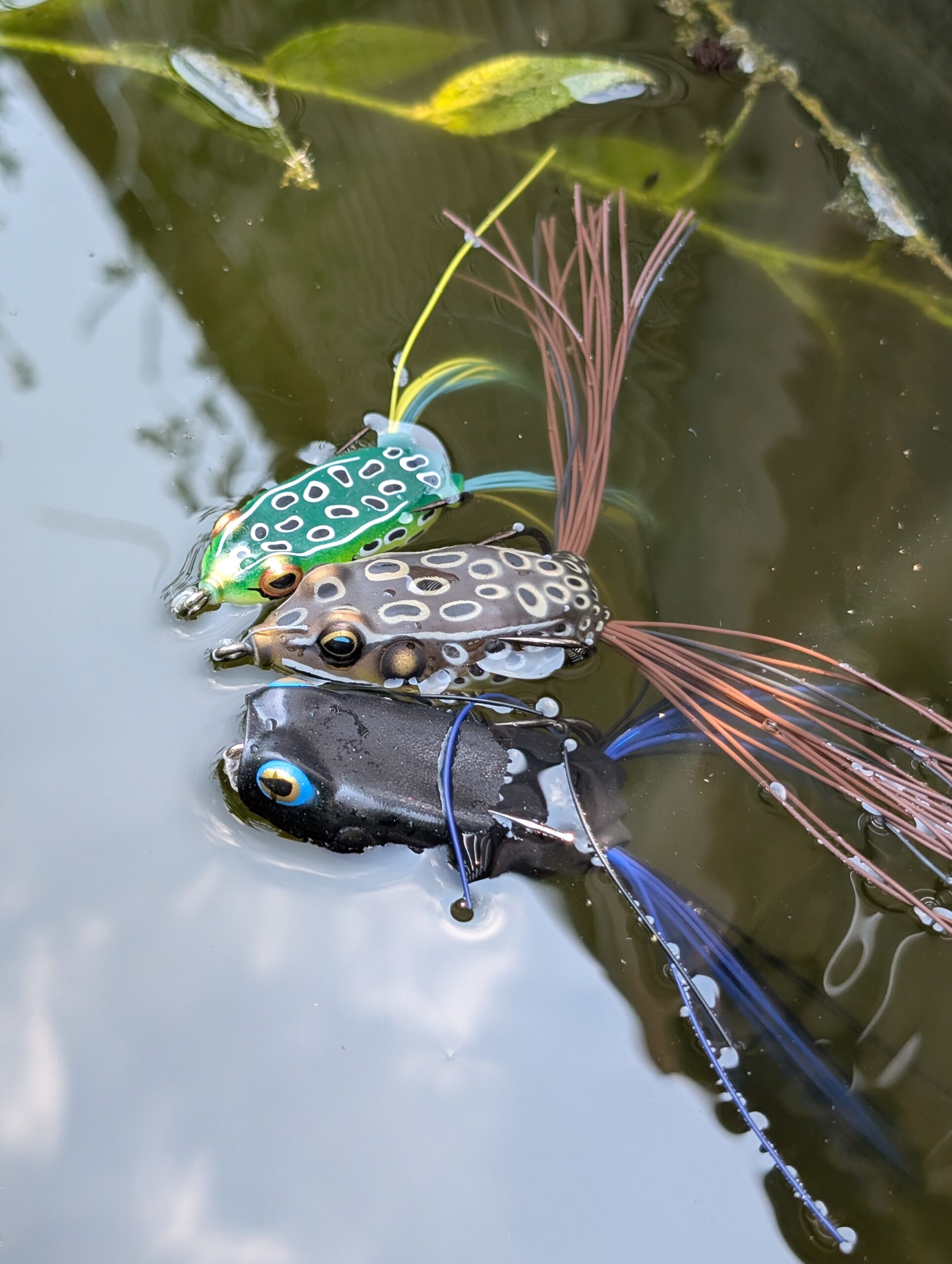
This is the arena of the hollow-body topwater frog. It is a visual, heart-stopping style of fishing where you don’t feel the bite on the line—you see and hear a violent explosion that will make you jump clean out of your sandals.
The Frog Tuning Blueprint
Right out of the package, most store-bought frogs are only running at 70% of their actual potential. To wrestle five-pound Kawartha bucketmouths out of thick vegetation, you need to modify your bait like a pro.
🐸 The Pro-Frog Modification Strategy
| Modification Step | How To Do It | The Tactical Purpose |
| Trim the Skirt Legs | Take a pair of scissors and cut one leg about 1 inch shorter than the other. | The “Walk-The-Dog” Trick: The uneven leg lengths create a dramatic side-to-side pivoting action with almost zero forward movement, keeping the frog in small pad openings longer. |
| Open the Hooks | Use heavy pliers to gently bend the double hooks up and out away from the plastic body by about 3 millimeters. | The Hookup Insurance: Out-of-the-box frogs often have the hooks pressed too tight to the body. Bending them open slightly dramatically increases your hook-setting percentage in heavy weeds. |
Tactical Execution: The 2-Second Rule
When casting into a thick field of lily pads, fire your frog directly onto the shore or right into the densest pocket of the weeds. Work the bait slowly, twitching your rod tip on slack line to make the frog dance and walk across the tops of the pads. When it hits a small pocket of open water, let it sit perfectly still until the ripples disappear.
That open pocket is the kill zone.
                                              [THE HOLLOW-BODY FROG STRIKE ZONE]

                  ☘️☘️  [Lily Pads]  ☘️☘️                                                    ☘️☘️  [Lily Pads]  ☘️☘️
      ──────────────────┐             ┌──────────────────
                                                                           │  🐸 [Frog]  │
                                                                            │   (Pause)   │  ◄── THE KILL ZONE
           ═══════════════════╧═════════════╧═══════════════════
                                                                          🐟 [Bass]
                                                                  (Rising from bottom)
When a giant bass tracks the vibration under the pads and decides to wallop it, your natural instinct is going to be to rip the rod back instantly. Don’t do it. If you set the hook the second you see the splash, you will pull the frog right out of its mouth 90% of the time.
When the explosion happens, wind down your slack line, count out loud—“One, Two”—and wait until you actually feel the heavy weight of the fish bending your backbone. Only then do you deliver a violent, overhead hookset. Spool up with nothing less than 50-pound braid, lock your reel’s drag completely flat, and immediately start winding. It’s a pure winch-fest to get that fish’s head up before it buries itself into twenty pounds of Kawartha salad!