Disclaimer: This post contains affiliate links. As an Amazon Associate and member of other affiliate programs (including Temu), I earn from qualifying purchases. If you click a link and make a purchase, I may receive a small commission at no extra cost to you. I only recommend gear I genuinely trust.
Ask five different Ontario anglers where to find walleye in July and August, and four of them will tell you to head out to deep water. They’ll point you toward 30-foot rocky reefs, deep mud flats, or main-lake drop-offs. But if you are fishing shallower, nutrient-rich water systems—like the Kawartha Lakes, Pigeon Lake, or the slow-moving river stretches across central Ontario—deep water isn’t just hard to find; it’s often completely devoid of fish.
The truth is, a massive population of summer walleye never makes a deep-water migration. Instead, they lock directly into the thickest, greenest weed edges they can find in 8 to 12 feet of water.
Learning how to target these “weed walleyes” without constantly fouling your hooks is the ultimate summer hack. Once you understand how to break down the greenery, you can unlock some of the fastest, most aggressive walleye action of the entire year.
1. The Summer Walleye Shift: Why Green Weeds Mean Gold
The old-school belief that walleye hate shallow water in the summer comes down to temperature. True, walleye prefer cooler water, but they require two other things even more: oxygen and food.
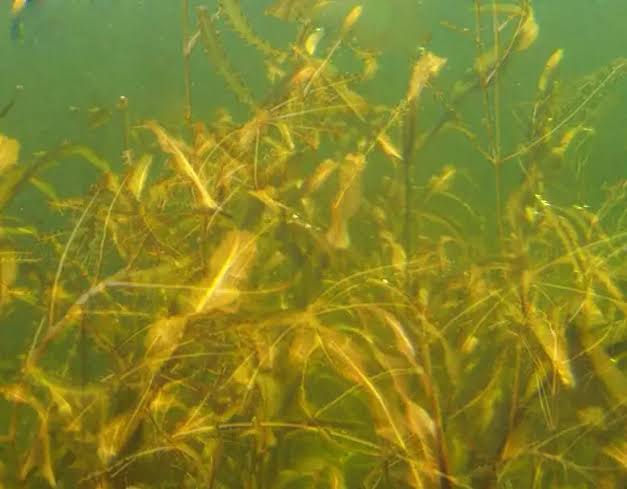
By mid-summer, deep basin water in shallower lakes can become stagnant and low on oxygen. Meanwhile, thick, vibrant weed beds—specifically broad-leafed cabbage and healthy coontail milfoil—act as massive underwater oxygen factories. Under the blazing summer sun, these plants pump pure oxygen into the water column.
This oxygen-rich environment creates a bustling aquatic ecosystem. Schools of yellow perch, emerald shiners, and young-of-the-year panfish flood the weed beds for shelter and food. For a predatory walleye, the weed line becomes a shaded, air-conditioned buffet. Instead of roaming the empty mud flats, they tuck right into the shadows of the weed canopy, waiting to ambush anything that swims by.
2. The “Weed-Ripping” Technique: Triggering Reaction Strikes
The biggest barrier to catching weed walleye is the fear of snagging. If you try to drag a standard live-bait rig or slowly roll a spinner through thick vegetation, you will end up cleaning green slime off your hook on every single cast.
To fish the jungle successfully, you have to stop trying to avoid the weeds and start using them to your advantage. Enter the Weed-Ripping technique.
The Setup
Instead of a light jig, you scale up to a 1/4 oz or 3/8 oz jig head tipped with a 3- to 4-inch paddle-tail swimbait or a traditional bucktail jig. You need that extra weight to make the lure drop quickly.
The Cadence
Cast the jig directly into the weed flat or along the edge and let it sink. As you slowly retrieve it, you want the lure to contact the plants. The moment you feel your line go heavy or tick a weed blade, do not pull gently. Instead, snap your rod tip upward violently.
This sudden, powerful pop does two things:
- It shears the lure cleanly through the weed stalk, popping it free without getting fouled.
- It causes the bait to suddenly erupt out of the greenery and dart upward, followed immediately by a rapid, erratic nose-dive back toward the bottom.
To a walleye sitting in the shadows, that sudden eruption looks like a baitfish panicking and fleeing. It triggers a pure, instinctual reaction strike. They don’t taste it or inspect it—they smash it on the drop.
3. High-Percentage Areas: Inside Corners and Sand Pockets
You shouldn’t just cast blindly at a massive, mile-long wall of weeds. Like any good hunter, walleyes look for specific structural anomalies along the greenery that give them a distinct tactical advantage over their prey. When breaking down a weed bed from a boat or kayak, hunt for these two high-pressure zones:
Inside Corners
When you track a weed line with your electronics or your eyes, you’ll notice it doesn’t run in a straight line. It bends, curves, and snakes along the contour of the lake bed. An inside corner is an area where the weed edge makes a sharp turn inward toward the shoreline, creating a natural U-shaped pocket.
Whenever the wind blows against a weed bed, wind-driven currents push schools of baitfish along the edge until they hit one of these inside corners. The baitfish get trapped in the pocket, and walleyes will school up heavily in these exact spots to corner and harvest the bait.
Bottom Transitions (The Sand Pockets)
Thick cabbage beds require soft, nutrient-dense sediment to grow. If the lake bottom suddenly transitions to a hard sand bar or a patch of gravel, the weeds will instantly stop growing, creating a clean, open bald spot right in the middle of the jungle.
Walleyes absolutely love these transitions. They will bed down in the thick weeds right on the perimeter of the sand pocket, using the dense growth as camouflage while keeping their eyes locked on the clear, open sand where baitfish have nowhere to hide.
4. The Best Budget-Friendly Walleye Spinning Combo
To successfully rip heavy jigs through thick Ontario vegetation, your standard, ultra-bendy panfish rod won’t cut it. You need a setup with serious muscle to snap the weeds, but enough sensitivity to feel a walleye inhale the bait on a slack line. Here is a bulletproof, budget-friendly setup that punches way above its weight class.
1. The Rod: Daiwa Aird X Spinning Rod (Approx. $75 CAD)
- The Specs: 7’0″ Length, Medium Power, Fast Action.
- Why it wins: For under eighty bucks, the Aird X is an unbelievable value. It is constructed from high-quality graphite reinforced with Daiwa’s “Braiding-X” technology, which prevents the rod blank from twisting under heavy pressure. The Medium power gives you the exact stiff backbone required to snap a 3/8 oz jig through thick milfoil, while the fast tip transfers the vibration of a subtle walleye bite directly to your hand.
2. The Reel: Pflueger President Spinning Reel (Size 30) (Approx. $90 CAD)
Why it wins: The Pflueger President is a legendary workhorse in the Canadian angling community. The size 30 is the ultimate utility size for walleye. It features a 10-bearing system that stays silky smooth season after season, and its aircraft-grade aluminum handle gives you plenty of cranking leverage when you need to horse a big fish out of the weeds before they wrap you up.
3. The Line Formula
Do not use straight monofilament line for this technique—the stretch will absorb your rod snaps, and you will just end up stuck in the weeds.
- Main Line: 10lb to 15lb Braided Line. Braid has zero stretch, allowing you to cleanly slice through plants on the snap.
- Leader: A 3-foot piece of 12lb Fluorocarbon. While walleye aren’t always line-shy in the dark weeds, the heavy fluorocarbon is incredibly stiff and abrasion-resistant, preventing rough weed stalks and sharp gill plates from wearing down your line.